I believe thinking is everything.
Not only intelligence. Not only talent. Not only hard work — although hard work matters deeply.
Thinking. The way you approach a problem. The way you interpret evidence. The way you decide what to believe, what to doubt, and what to change your mind about.
History is full of moments where progress did not begin with a new fact, but with a new way of processing reality:
Newton did not simply discover gravity — he gave the world a new way to think about motion. Darwin did not simply notice differences between animals — he gave the world a new way to think about life, variation, and adaptation. Einstein did not simply write — he gave the world a new way to think about space, time, mass, and energy.
Again and again, human progress begins when someone changes the framework through which reality is understood.
That is why Bayesian thinking matters.
Bayesian thinking is not just a formula in a probability textbook. It is a philosophy of fluid intelligence. It gives us a simple but powerful mandate: start with what you currently believe, look at the new evidence, and then update your belief in proportion to how strongly that evidence supports one possibility over another.
It is the mathematical shape of learning itself. It is how human minds reason, how science advances, and how modern Artificial Intelligence operates. Because at the core of all intelligent systems lies a single brutal challenge: dealing with uncertainty.
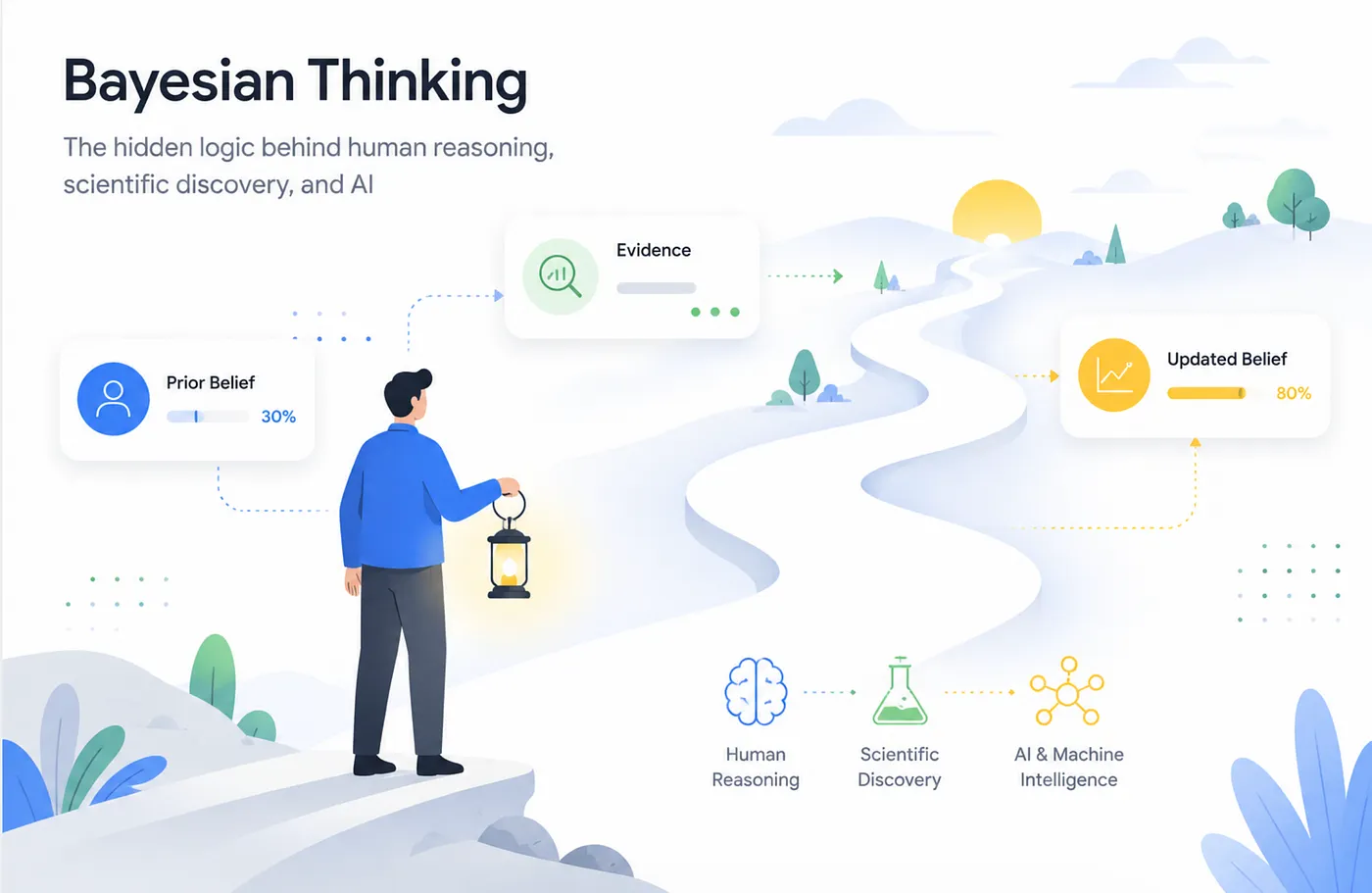
How We Actually Think
Imagine you wake up in the morning, look outside, and see a heavy, dark sky. The air feels thick. The wind has shifted. Before checking your weather app, your mind instinctively forms a hypothesis: it may rain today.
Why? Because your mind is using past experience. You have seen dark skies before. You begin with a background belief — known in statistics as a prior.
Then new evidence arrives. The sky gets darker. The smell of petrichor fills the air. A distant roll of thunder.
Each piece of evidence moves your degree of confidence:
This is Bayesian thinking in ordinary life. You did not jump from complete ignorance to absolute certainty. You updated gradually, proportionally, honestly.
Most real thinking is not about binary certainties. It is about degrees of confidence. You rarely know things absolutely. Instead, you assign probabilities — consciously or not — to the world’s messiest questions: Is this person trustworthy? Will this decision work out? Is what I’m reading actually true?
We Live in Uncertainty — and Always Reason Backwards
The world rarely hands us complete information.
Doctors do not see diseases directly — they observe symptoms and lab results. Detectives do not see crimes happen — they see clues. AI systems do not understand the world the way we do — they ingest patterns in data to infer underlying realities.
In all these cases, we face the challenge of backward reasoning.
If you know a coin is fair, asking the probability of heads is forward reasoning — easy. The real world asks the reverse: “I just observed 8 heads out of 10 flips — what does this tell me about the coin?”
Science, medicine, law, and AI all work backward. We observe effects and infer causes. This is the inverse problem — and for a century after the birth of probability theory, it had no rigorous answer.
The mathematics of chance began in 1654, when a French gambler named Chevalier de Méré brought a problem to Blaise Pascal. Pascal brought it to Pierre de Fermat. Their correspondence that summer is the founding document of probability theory.
But what Pascal and Fermat built was entirely one-directional — forward reasoning only. Given a known model, predict outcomes. They could not go the other way: given observed outcomes, infer the underlying model.
For a century after them, this backward question had no answer. Then a philosopher came along and made the problem dramatically worse.
The Philosophical Crisis: Hume’s Unanswerable Question
In 1739, the Scottish philosopher David Hume published A Treatise of Human Nature. Inside it was an argument so simple and so devastating that it is still not fully resolved today.
Hume started with a question that sounds innocent: how do we know anything about the world beyond what we directly observe right now?
Everything we believe about the unobserved — the future, general laws, causes and effects — comes from induction: observing particular instances and drawing general conclusions. We have seen fire produce heat hundreds of times, so we conclude fire always produces heat. We have seen the sun rise every morning of recorded history, so we conclude it will rise tomorrow.
All of science rests on this.
Hume then asked: what justifies induction?
He presented a dilemma with two possible answers — both of which fail.
Option 1: Logic justifies induction. Can you prove by pure reasoning alone that the future must resemble the past? No. There is no logical contradiction in imagining the sun not rising tomorrow. Deductive reasoning cannot justify induction.
Option 2: Past experience justifies induction. You might say: induction has worked reliably before, so we have good reason to trust it. But this justification is itself inductive — you are saying induction worked in the past, therefore it will work in the future. You are using induction to justify induction. The argument is perfectly circular.
Both exits are blocked.
This was a philosophical earthquake. Every scientific claim ever made rests on inductive inference. And Hume had just shown that this foundation had no logical ground beneath it.
Bayes’ Answer — Precise, Humble, and Revolutionary
Thomas Bayes was an English Presbyterian minister. He published almost nothing in his lifetime — a theological paper, a defense of Newton’s calculus against Berkeley’s criticisms. He died in 1761 with an unfinished manuscript in his papers.
His friend Richard Price found it. Price was himself a philosopher and mathematician — and crucially, he had read Hume. He spent two years completing Bayes’ paper, adding his own proofs, and writing the philosophical framing Bayes had left incomplete. In December 1763, he presented it to the Royal Society under the title: An Essay Towards Solving a Problem in the Doctrine of Chances.
But Price chose a different title for the separately printed copies distributed to interested readers. The historian Stephen Stigler of the University of Chicago found these offprints. The title Price chose was:
A Method of Calculating the Exact Probability of All Conclusions Founded on Induction.
Every word is aimed directly at Hume.
All conclusions founded on induction. Not some — all. And not vague, imprecise, habitual conclusions — exact probability of those conclusions. A precise, calculable, mathematically rigorous answer to the question Hume said had no rational foundation.
What had Bayes actually solved? He solved the inverse problem that Pascal and Fermat never touched. He didn’t prove Hume wrong — you cannot prove Hume wrong. The logical circularity of induction is real and unresolved. What Bayes did was something more pragmatically powerful: he showed that even granting Hume’s point, you can still calculate precise, defensible degrees of belief from observations. And you can calculate exactly how much each new observation should update those degrees.
You replace the impossible demand for certainty with something honest and useful: a precise calculus of rational confidence, continuously updated by evidence.
From the Ground Up: The Village Example
Before the formula, feel the logic.
Imagine a village of 100 people. 30 are farmers, 70 are not. A villager walks toward you from a distance. Your prior belief: 30% chance they’re a farmer.
Then you notice: muddy boots.
Something shifts automatically. Muddy boots are more common among farmers. The evidence has moved you — but by exactly how much?
When you learn this person has muddy boots, you eliminate a column. You no longer care about all 100 people — only the 38 with muddy boots.
Of those 38, how many are farmers? 24 out of 38 ≈ 63%.
You started at 30%. You landed at 63%. The muddy boots did that — not gut instinct, but the precise ratio of worlds where your hypothesis is true to the total worlds consistent with the evidence.
The Anatomy of Bayes’ Theorem
When we map this mathematically, we need one foundational definition. The conditional probability — the probability of given that is true — satisfies:
By symmetry, we can also write this as . Setting these equal:
Divide both sides by , and you have Bayes’ theorem:
Where is your Hypothesis and is the Evidence. Four parts, each essential:
— The Prior. Your belief before the new evidence arrives (30% in our village). A prior is not arbitrary bias — it is your accumulated background knowledge compressed into a number. Ignoring the prior is why people panic over rare medical diagnoses. A positive test for a disease that affects 1 in 1,000 people is not the same as a 99% certainty you have it. The prior matters enormously.
— The Likelihood. How probable is this evidence if your hypothesis is true? (80% of farmers have muddy boots). Good hypotheses make bold, testable predictions. A theory that explains everything perfectly only after seeing the data earns no Bayesian credit — the hypothesis was designed to fit, so the evidence no longer discriminates.
— The Normalising Constant. How common or surprising is this evidence overall? (38% of the village has muddy boots). This is the reality check. Common evidence — things you’d see regardless of which hypothesis is true — barely moves you. Rare, surprising evidence moves you dramatically. This is the mathematical reason behind something you’ve heard your whole life: extraordinary claims require extraordinary evidence. It’s not a saying. It’s the denominator.
— The Posterior. Your updated belief after the evidence (63%). This immediately becomes your new prior when the next piece of evidence arrives — creating an infinite learning loop. Today’s conclusion is tomorrow’s starting point.
The Full Form
The denominator is often the hardest to compute directly. We can expand it using the law of total probability, summing across all mutually exclusive hypotheses:
Substituting into Bayes’ theorem gives the full expanded form:
Worked Through for the Village
Let us verify our contingency table result from first principles.
- Prior: , so
- Likelihood:
- False positive rate:
The total evidence probability:
And the posterior:
63.2%. The same answer as counting cells in the table — but now derived purely from the formula. The two paths converge, as they must.
The Architecture of Machine Intelligence
Artificial intelligence can look like magic from the outside. Beneath it, much of modern machine learning is fundamentally Bayesian.
The explicit version is a Naive Bayes spam filter. It parses an incoming email and calculates . It knows how frequently words like “prize,” “winner,” and “urgent” appear in spam versus normal email — and shifts its confidence accordingly. Your spam folder exists because of Bayes’ theorem.
The implicit version is every neural network ever trained.
A neural network looks nothing like Bayes’ formula on the surface — layers of numbers, weighted connections, gradients flowing backwards through training. But what is it actually doing? It starts with initial weights (a prior, implicit in the architecture). It sees training data (evidence). It adjusts those weights to better predict what it has seen — it is moving toward the parameters most probable given the data. The trained network is the posterior. Bayesian inference, approximated by gradient descent.
The most visible version is large language models.
Every time a language model generates a word, it is computing:
Your prompt is the prior constraint. Every word generated shifts the probability distribution of what should come next. The model maintains context, adjusts to what you say, produces responses that take your specific situation into account — because it is doing this Bayesian updating hundreds of times per second.
The core philosophy across all of these: intelligence is prediction under uncertainty, continuously refined by evidence. Whether the system is a spam filter, a neural network, or a language model — the underlying structure is the same.
What Bayesian Thinking Demands of You, Personally
This is where the mathematics becomes practical.
Human beings are notoriously poor intuitive statisticians. We overreact to vivid stories. We ignore base rates. We under-update when evidence is uncomfortable and over-update when it confirms what we already believe. We are not naturally Bayesian — we are naturally fast and approximate.
Bayesian thinking is the correction.
Stop confusing the two directions. is not the same as . Most people with a rare disease have a certain symptom — but that does not mean most people with that symptom have the rare disease. Prosecutors, doctors, and journalists make this confusion constantly. Recognising it protects you from a large class of bad conclusions.
Earn your certainty. If you cannot name a single piece of evidence that would cause you to update a core belief, you are no longer reasoning — you are protecting a position. Bayesian thinking keeps every empirical belief permanently, in principle, revisable. Probability exactly 1 means nothing could ever change your mind. That is not confidence. That is dogma.
Before reacting to any claim, ask four questions:
- What was my prior — what did I believe before this arrived?
- How strong is this evidence — is it statistically sound, or just emotionally vivid?
- Does this evidence discriminate — would I see the same data if my current belief were wrong?
- How much should I update — a little, or a lot?
These questions do not slow down good thinking. They are good thinking, made explicit.
Conclusion: The Art of Becoming Less Wrong
The ultimate lesson of Bayesian thinking is not found in its algebraic syntax.
It is found in its humility.
A rational mind is not a mind that never changes. A rational mind is a mind that changes exactly the right amount in response to reality — not more because the evidence is emotionally compelling, not less because the conclusion is uncomfortable.
It begins with a prior. It receives evidence. It updates. It repeats.
That is how humans learn. That is how science advances. That is how machines think.
From an unfinished manuscript found in a dead minister’s papers — given to the world by a friend who understood its implications — to the algorithm running inside every AI model you interact with today. Not because someone decided Bayes was useful. Because there is, mathematically, no coherent alternative.
The equation was always true. We just kept rediscovering it.
True intelligence is simply the willingness to hold your convictions loosely, face reality honestly, and commit to becoming progressively less wrong over time.
References: Bayes, T. & Price, R. (1763). An Essay Towards Solving a Problem in the Doctrine of Chances. Philosophical Transactions of the Royal Society. · Hume, D. (1739). A Treatise of Human Nature. · Hume, D. (1748). An Enquiry Concerning Human Understanding. · Laplace, P.S. (1814). A Philosophical Essay on Probabilities. · Stigler, S.M. (2013). The True Title of Bayes’s Essay. Statistical Science, 28(3).